
Stop renting your critical software: How to build the business case for ownership
Third-party software libraries are everywhere, with studies suggesting they underpin more than 90% of modern software projects. For many organisations, licenses for pre-written code have become a predictable operational expense (OpEx), promising fast delivery, automatic updates, and seamless access to the latest features.
But this convenience comes at a cost. When you don’t control the software, you risk losing traceability, breaching safety or quality standards, and becoming dependent on a third-party vendor’s roadmap and stability.
For highly regulated embedded projects, building and owning your own software can be a smart alternative. The tricky part? Convincing those in charge of the budget that a capital expenditure (CapEx) model makes financial sense.
In this blog, we’ll unpack the core differences between OpEx and CapEx and show you how you can build a watertight business case for software ownership that wins support across your organisation.
Why CapEx makes sense for embedded software
At its simplest, CapEx refers to significant purchases that you own for the long term, like a printer. OpEx typically involves rentals and recurring payments for consumable goods, such as printer ink. The same logic applies to software.
A single software license for a specialised piece of off-the-shelf software could cost a business £200k per year. That same business could develop its own software and recoup the costs in just five years, retaining full ownership and control of its IP.
Investing in software ownership also mitigates some of the risks associated with using third-party software. For embedded systems subject to safety and quality standards, this is especially true, as any unexpected change can disrupt validation and compromise compliance.
Picture this: an organisation faces rising annual license fees for a third-party system that can’t meet the safety-critical requirements of IEC 62304. By investing once to build and own their software, they could spread, or amortise, the cost over several years. This guarantees compliance and turns an expense into an asset, likely halving the annual figure on their profit and loss (P&L) sheet.
For compliance-sensitive products, CapEx ownership isn’t just a financial model—it’s a strategy for stability, accountability, and long-term value. But to rally the stakeholders to your cause, a persuasive—but accurate and quantifiable—software business case can make all the difference. Now, let’s help you build a winning business case.
What to include in your CapEx business case
When building your business case, remember to demonstrate both technical and financial value. Financial decision-makers want to see you justify their investment through predictable, long-term profit for the organisation and its shareholders.
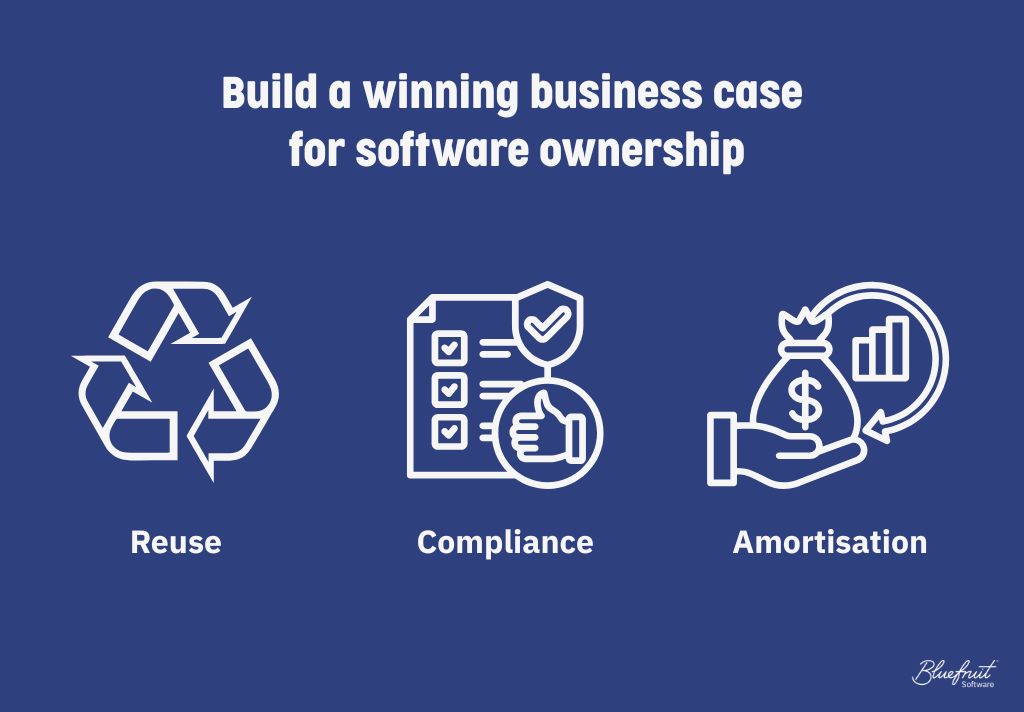
Here are three headline benefits your CapEx business case needs to include:
- Strategic value: autonomy, reuse, and licensing
Position the creation and ownership of original software IP as a strategic enabler rather than a frivolous, short-term expense. Instead of being tied to a third-party provider’s roadmap, codebase, or update cycle, you’re in control of its features and development.
Highlight how this flexibility lets your teams respond faster to shifting customer needs, regulatory changes, and market disruptions. The software is yours, and you decide what it does, when it evolves, and who can use it.
IP ownership also enables reuse across future projects—without having to renegotiate or pay for additional licenses—and can even open new revenue streams through third-party licensing or service-based offerings. Framing CapEx this way can help decision-makers see it as a measurable investment in autonomy, resilience, and expansion.
- Compliance and risk: stay in control, reduce exposure
For embedded and safety-related systems, meeting standards such as IEC 61508 and IEC 62304 is necessary for market access and certification. It also helps protect against reputational and financial damages linked to product recalls or failed audits.
Maintaining control over that software is crucial to staying compliant. When software is supplied or managed externally, even minor, unverified code changes can complicate validation and interfere with safety-critical functions such as fail-safes.
So, how can a CapEx approach mitigate these risks? By taking ownership, your team decides testing schedules, when updates go live, and how documentation is kept. It doesn’t eliminate risk entirely, but it’s far easier to stay traceable and accountable.
For decision-makers, quantify the potential cost of compliance failures, such as lost sales, revalidation, and downtime. Compare this with the cost of building and owning compliant software to clearly show risk reduction as a measurable value.
- Financial benefit: Show value in amortisation
While we’ve already touched upon the financial benefits of software ownership, this is where you cement your case by referencing persuasive accounting concepts, such as amortisation, to show tangible long-term value.
Finance teams love predictability, and under a CapEx model, you can deliver exactly that—but only if software spend can be amortised. This spreads development costs across the software life cycle, turning a one-time investment into predictable, annual entries on your profit and loss (P&L) statement.
A practical example can help illustrate the point. For instance, replacing a £200k annual license fee with a one-off £500k build amortised over five years equates to roughly £100k each year on the P&L sheet.
You can further strengthen your case with simple visualisations, such as a side-by-side table showing projected license costs versus the amortised outgoings.
Build your business case with proven expertise
Your business case is about more than just numbers; it’s about demonstrating you can deliver lasting value, compliance, and resilience through software ownership. CapEx can help you do just that, and together, we can make it happen.
If you’re looking to develop your own software IP, shift to a CapEx model, or just need help building a business case for investment, get in touch.
Did you know that we have a monthly newsletter?
If you’d like insights into software development, Lean-Agile practices, advances in technology and more to your inbox once a month—sign up today!
Find out more