
Embedded AI development
Safe and compliant AI for your device and development process
Whether you’re adding artificial intelligence (AI) to an existing product or designing a new system around it, we build it into embedded hardware, accounting for memory, power, processing, and regulatory constraints. Bluefruit’s software teams have extensive experience developing, integrating, and testing embedded AI software for medical devices, industrial equipment, and other safety-critical systems.
We help engineering teams rigorously evaluate model performance, robustness, and limitations, and integrate AI components into systems developed to support compliance with applicable standards and regulatory guidance, including IEC 62304, IEC 61508, DO-178C, and FDA guidance for AI-enabled medical devices.
What is embedded AI?
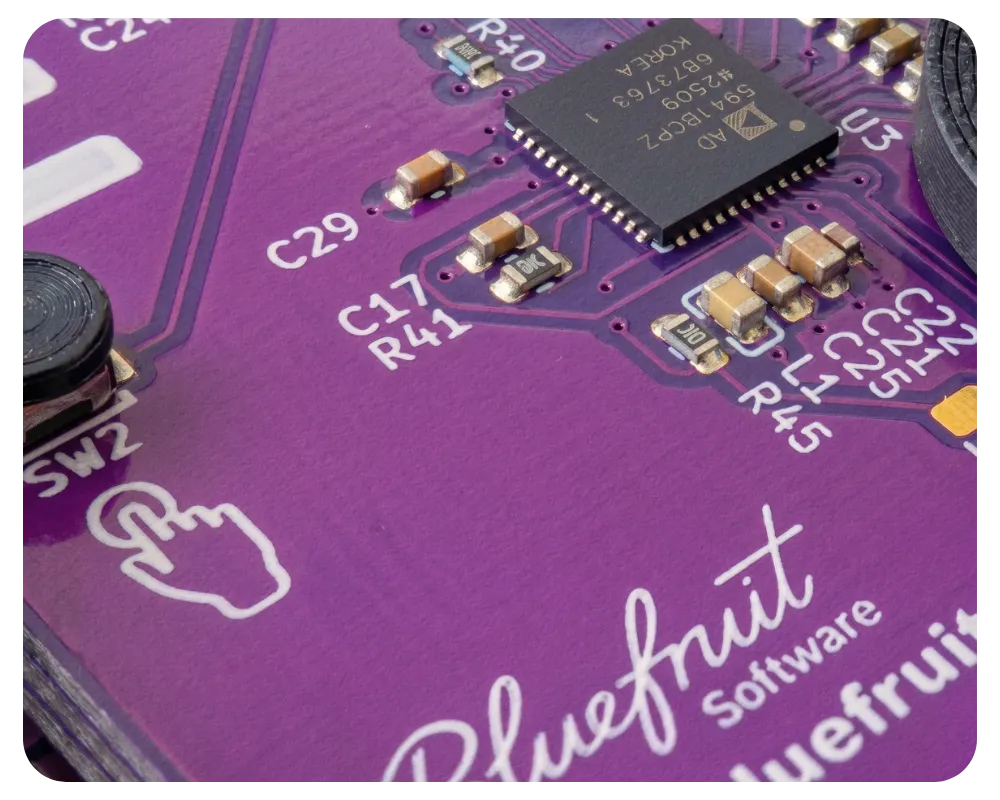 Embedded AI is artificial intelligence, such as machine learning models, computer vision, intelligent control algorithms, or sensor fusion, that runs on the device itself and is built into a product’s software. It enables an embedded model to run autonomously, assessing data and acting upon findings without an external connection to a cloud network.
Embedded AI can reduce or eliminate bandwidth requirements for real-time decisions, improves speed, preserve privacy, and keep systems functional in the absence of a network.
Embedded AI and edge AI are not the same thing
While both terms describe AI running outside a cloud environment, embedded AI and edge AI carry different assumptions about hardware capability and connectivity, directly affecting algorithm choices and deployment architectures. Edge AI is the broader term for systems outside a cloud data centre, running from small, resource-constrained devices to more capable edge hardware. Embedded AI sits entirely at the constrained end of that range.
Simply put, embedded AI is always a form of edge AI, but not every edge AI system faces the tight hardware constraints an embedded product does.
Our embedded AI development services
Cloud and edge AI architecture
We’ll assess your product’s constraints, connectivity, latency, and power early in the design process and help you decide which features can run on the device and, where required, which connect back to a server.
Model selection and optimisation
Not every model that performs well in a research paper is one you can run on your target hardware. We choose and adapt models with your device’s real limits in view from the start, so the version that ships is one that fits, not the best-performing version cut down after the fact.
RTOS and bare-metal integration
AI code has to live inside the same real-time constraints as everything else on your device. We integrate model inference into RTOS-based and bare-metal systems without compromising the timing guarantees your product depends on.
Safety-critical validation and regulatory compliance
A trained model’s outputs depend on the data it was trained on in ways that plain code doesn’t, so verifying it requires more than traditional code coverage. We integrate compliance directly into development to meet safety standards such as IEC 62304.
Hardware acceleration and toolchain selection
Getting a model to run on constrained hardware often comes down to using the chip features, whether that’s a dedicated accelerator, instruction support, or a compiler toolchain. We choose that path based on what your hardware supports and what your product needs.
Performance optimisation
A model that works in principle still needs to run within real power and thermal budgets and be fast enough to be useful. We tune for the constraints that matter for your product and consumer experience, not for a benchmark score that doesn’t reflect how it’ll be used.
The benefits of embedded AI
Embedded AI changes what a device can do on its own. Moving inference onto the device itself, rather than a server, reshapes speed, cost, reliability, and privacy all at once.
Real-time decision-making
Instant local inference lets devices process sensor data immediately, automate responses, and operate independently in places where speed, reliability, and continuous operation matter most.
Reduced cloud dependency and lower costs
Processing neural workloads on devices uses less bandwidth and lowers cloud costs. Embedded AI can reduce expenses and make it easier to scale distributed systems and connected products.
Low-latency system performance
Performing computations on the device reduces delays and makes systems more responsive. This is especially important for robotics, industrial automation, automotive safety, and real-time monitoring, where quick decisions are needed.
Multimodal data processing
Bringing together data from sensors, computer vision, telemetry, and neural processing improves accuracy and provides more reliable insights for operations.
Improved data privacy and security
Keeping processing local reduces the risk of exposing sensitive information. This helps organisations stay compliant, strengthen cybersecurity, and protect confidential or user-generated data.
We can retrofit AI into your product
Adding AI to a product you’ve already built doesn’t always mean new hardware. Retrofitting AI onto an existing device is often possible in software, through a model that reads data your product already collects. We’ll tell you early if your product needs new hardware to do what you’re asking, and help you decide where AI adds genuine value, and where it doesn’t.
AI testing and evaluations
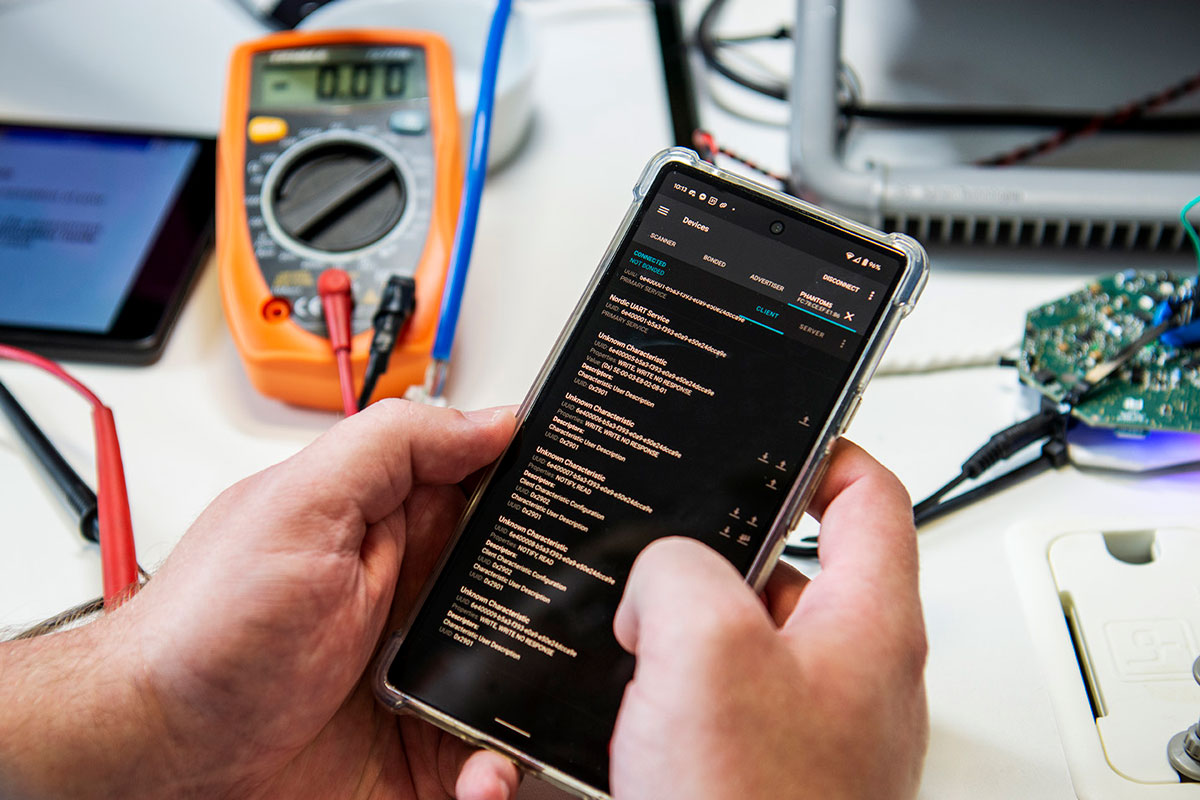 Testing an AI feature isn’t the same job as testing the code around it. A model’s output depends on the data it’s trained on, so a test suite built for deterministic code doesn’t automatically tell you whether the model itself is behaving correctly. We test for performance against your product’s real requirements, run scenario-based checks built around how the model will be used, and treat a model’s behaviour as something to keep checking rather than something a single pass proves once and for all.
We also help clients build, audit, and evolve their own AI eval strategies as their products and models change. Because your eval suite defines the pass-or-fail bar, you can adapt the underlying model without rewriting your tests.
Predicting engine health through vibration signatures
When a specialist in critical communications and intelligent systems, working across marine, nuclear, aerospace and defence, needed to know if an engine was about to fail, we took a machine learning AI and put it in an embedded device for real-time autonomous engine health monitoring and fault prediction.
The device could be retrofitted to an engine and would assess vibrations to learn the healthy “signature” during a learning period, then flag the moment it starts to change.
Embedded AI development process
Whether we take on full product development from a blank page through to a shipped device, or become an extension of your team to add AI capability to something already underway, our embedded AI teams follow rigorous test-first, Test-Driven Development (TDD), and continuous improvement practices using the same Lean-Agile methodology as the rest of our engineering.
We agree priorities sprint by sprint rather than locking in a fixed plan up front. Once development begins, short, focused cycles let us deliver working software running on your hardware at the end of each sprint, because a model’s real behaviour only shows up once it’s running on the target. To ensure nothing breaks during development, we test during every sprint alongside development.
A proven history in software innovation
As AI capabilities evolve, our clients trust us to help them realise its value while staying true to their strategy, values, and regulatory requirements. From audio/visual recognition software and intelligent health monitoring systems to predictive maintenance for industrial machinery, our embedded engineers have turned complex ideas into market-ready products.
If you need support evaluating and safely applying AI to your products, our team will work closely with your project managers and device engineers to deliver quality embedded AI.
Frequently asked questions
AI insights and resources
Current and previous clients










Sign up to our newsletter
If you’d like insights into software development, Lean-Agile practices, advances in technology and more to your inbox once a month—sign up today!
