
How to get the best from your regression testing strategy
Without the right guardrails, embedded software development can easily become overwhelming. What starts as a simple project may grow into a complex tangle of hardware revisions, evolving feature sets, and toolchain updates—ever shifting what was once a clear goal.
To keep pace, teams must continually revise and build on their code. Yet with every update, there’s a risk of unintentionally breaking behaviour that previously worked as expected. And without a reliable way to detect these issues early, defects can slip by undetected until they become costly to fix and disruptive to delivery. Or worse, they may emerge in shipped products, leading to emergency recalls and reputational damage.
This is where proactive regression testing can help, yet it’s a practice often delayed or dismissed altogether. In this article, you’ll learn why that happens, the risks it creates, and how you can adopt a more effective, autonomous approach to testing.
What exactly is regression testing?
Regression testing is the practice of re-running tests after code changes to verify that the software still performs as intended. The regression itself refers to a change that causes the previously correct behaviour to stop working as it should.
You can perform regression testing manually or automate it through scripts that repeatedly execute tests and verify results against expected outcomes.
Manual testing is typically preferred for exploring new or evolving behaviour, where the outcomes are not yet fully understood, such as when you want a clear answer to the question, “What happens if I try this?” Automated regression testing is better suited to verifying known behaviour repeatedly without human intervention. But more on that later.
Without regression testing, introducing new functionality can have unexpected knock-on effects on other parts of the software. In embedded systems, this can negatively impact performance, reliability, or security in ways that are not immediately apparent.
Effective regression testing helps prevent these issues, so why is it likely that your development team are sidelining it?
What discourages routine regression testing?
Many teams struggle to maintain an accurate test suite. As development progresses, test cases can quickly become outdated, so steps that once reflected real system behaviour no longer apply. To review, update, or retire redundant tests consistently also takes time that developers and testers may not have to spare—especially when under pressure to deliver against a target ship date.
Some teams may resort to ad-hoc impact analysis, testing only the areas they believe a change will affect. While sensible, invalid assumptions can easily creep in, especially when complex interactions between timing, configuration, hardware, and software are so hard to predict. As such, regressions emerge in places no one expected to break.
It’s not uncommon for regression testing to be sidelined altogether during last-minute crunch periods, often in favour of adding new functionality. Plus, manual regression testing tends to be slow and resource-intensive, so teams accept the risk rather than invest the time. But this can come back to bite them—hard.
If regressions are found close to the deadline, costs can go up rapidly. Bugs introduced weeks or months earlier are harder to unpick, fixes may affect newer code, and teams can find themselves caught in repeated cycles of re-testing and re-analysis. In some cases, entire regression suites must be rebuilt, which may delay product delivery.
So, what’s the best way to mitigate this risk?
Normalise strategic automation and fast feedback loops
Regression testing is more effective when based on regular feedback—or what we call fast feedback loops. By enabling a culture of continuous, iterative testing, bugs are detected more quickly, and developers still have the relevant context in mind, making issues easier to diagnose and less disruptive to fix.
Automation can help you achieve these fast feedback loops by repeatedly verifying known behaviours, happy path tests, and high-risk areas at definable checkpoints. For example, your team may choose to automate regression tests at the end of each sprint, after significant changes, or before critical integration points—this also frees them to focus on optimising code, delivering new features, and accelerating releases.
In fact, 72% of QA teams now integrate automation alongside manual testing to deliver faster and more reliable results. That’s because manual testing still plays a vital role in exploratory testing. Running an embedded system in non-intended ways, probing edge cases, and investigating new or evolving features can uncover issues that automated tests are unlikely to catch. The most effective strategies combine both approaches.
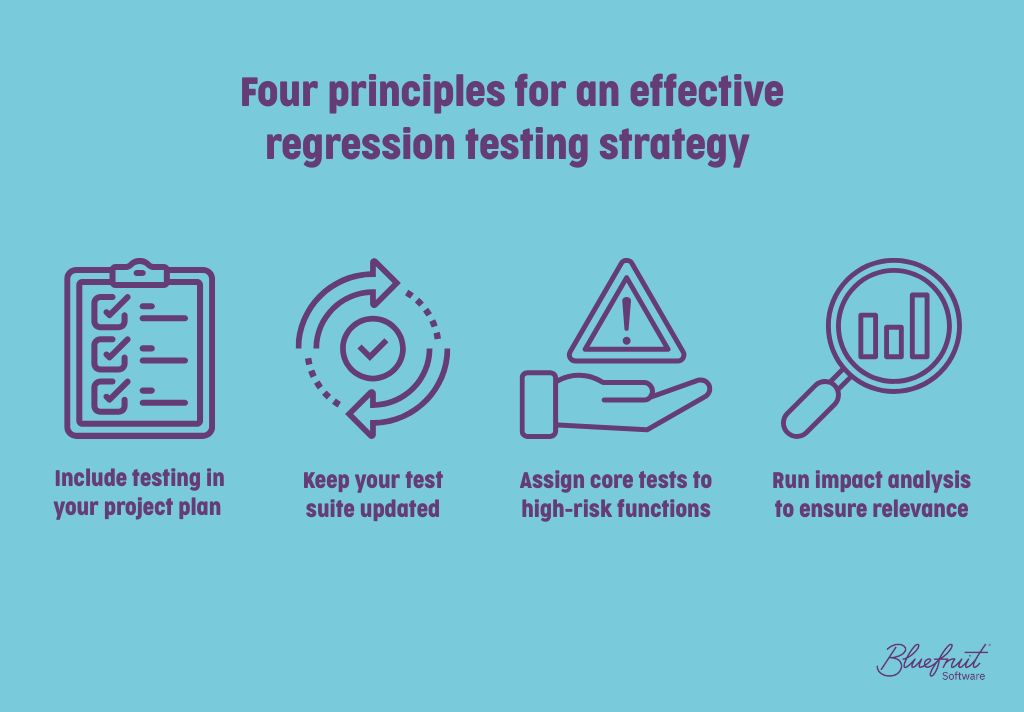
Here are four principles you can follow to help build an effective regression testing strategy:
- Include automated (and manual) regression testing in the project plan from the outset, including ownership, timing, and resourcing.
- Keep the test suite up to date by reviewing, updating, or retiring tests as the system evolves.
- Maintain a core set of regression tests that can be assigned to fundamental or high-risk functionality, even when resources are limited.
- Use impact analysis to run only relevant subsets of tests tied to updated software areas, without relying on it as the only safeguard.
Importantly, this approach is not limited to Agile teams. Traditional, linear Waterfall projects can also benefit from continuous regression testing, often requiring fewer test updates due to consistent feature sets.
Scale your testing capacity with confidence
Regression testing is rarely the most visible part of embedded software development, but it is one of the most important. Treating it as a continuous activity—rather than a final-phase hurdle—reduces risk, limits rework, and helps teams deliver software that does what it needs to, when it needs to.
For project leaders, the challenge is less about whether regression testing is necessary, but more about making it sustainable. By combining automation with targeted manual testing and a well-managed test suite, teams can keep control of change instead of becoming overwhelmed by it.
However, regression testing workloads will fluctuate. After major updates, your testing needs may expand, requiring additional personnel to manually test software and verify the results of any automated tests. But you may not want to maintain a large in-house test team during quieter update periods.
That’s where a proven, ad-hoc partner can help—providing a fresh perspective that scales with your team and project. This way, you only pay for and get the testing help you need, ensuring your embedded software is verified to do its job by that all-important deadline.
To discuss your testing strategy, needs, or challenges with our expert team, get in touch.
Did you know that we have a monthly newsletter?
If you’d like insights into software development, Lean-Agile practices, advances in technology and more to your inbox once a month—sign up today!
Find out more